Personal Journey & Leadership
You began your career in materials science and engineering. What pivotal realization led you from deep industrial engineering into founding an Industrial AI company?
I spent years working with metals, composites, and manufacturing processes, and one observation kept returning: the most critical information about what happens inside a manufacturing process is invisible to the people running it. Operators rely on indirect indicators—the sound of the machine, the temperature of the tool, the vibration they feel through the housing—combined with post-process inspections.
Over years and decades, the best operators develop a remarkable intuition built from these sensory impressions. They can hear when a tool is wearing down or feel when a process is drifting. But this is knowledge locked inside individual experience: informal, unscalable, and impossible to transfer when that person retires. By the time a defect is formally confirmed through inspection, the damage is already done.
Even when a qualified operator detects something wrong—through sound or feel—they often cannot react in time. The process is governed by strict standards and production requirements. Machines are designed to narrow variability in the product. But the real variable in this equation is not the machine itself. It is the material: different alloys, different batches, different suppliers, all interacting differently with the same tooling and process parameters. That interaction is what causes defects. And no amount of machine precision can eliminate it.
The turning point came when I started working with different types of nondestructive sensing—specifically sensing technologies rather than video cameras. Every material under stress emits signals that carry real-time information about its internal state: ultrasonic sounds, temperature changes, magnetic field shifts, and reflections of ultrasonic waves captured by specialized sensors. These phenomena reveal what is actually happening inside the process—micro-cracks forming, tool wear progressing, friction patterns shifting.
This is not new science. Nondestructive sensing has been studied for decades. But it was never made accessible or actionable for factory operators.
I realized that if we could digitalize the sensing capability of experienced operators—capture what they hear and feel, but do it continuously and precisely through electronic sensors—and then feed that data into modern machine learning algorithms running on edge computing devices, we could create something fundamentally new.
Think of it as an industrial nervous system: a network of sensors that feels what is happening at every critical point in the process, an AI layer that interprets those signals in real time, and an interface that gives operators and managers a higher-level understanding of what is actually happening inside their production.
That was the moment Ailoys was born—not as an automation company, but as an infrastructure company that gives manufacturing teams a direct, real-time connection to what their machines and materials are actually doing.
Everyone is talking about AI algorithms and computational power. Why did you choose to implement AI specifically in manufacturing? Does your cross-sector experience explain why you concentrate on the problem Ailoys is solving?
Right now, everyone is excited about artificial intelligence—the algorithms, the computational power. Computation is the new currency, people say. And yes, it is. But during earlier technology waves, smart investors were never chasing the hype itself. During the semiconductor revolution and the blockchain era, they invested in infrastructure: server racks, memory storage, cooling systems—the physical backbone that makes computation possible.
The same pattern is unfolding with AI. First came the excitement about algorithms and compute. Then people realized that all this computation requires enormous energy, so investment moved into energy production. Then that energy needed to be delivered, which meant cables and transmission infrastructure. Those cables require raw materials—copper, aluminum, and new high-performance alloys. And those materials need to be manufactured.
This is where the chain meets reality. The machines that produce these critical components are often decades old. The experienced operators who know how to run them are retiring. And the new materials demanded by the energy transition behave differently from what these machines were originally designed to process—different alloys, different mechanical properties, different failure modes.
So the question becomes: what do you do with this enormous installed base of industrial equipment?
Our answer is to make these machines intelligent—not by replacing them, but by adding a sensing and AI layer that makes them aware of what is happening inside the process.
My cross-sector experience—across aerospace, railway, energy, and lithium-ion battery manufacturing—showed me that this gap between machine capability and process intelligence is universal. It is the same problem in every sector. And it is an infrastructure problem, not an algorithm problem. That is why we built Ailoys.
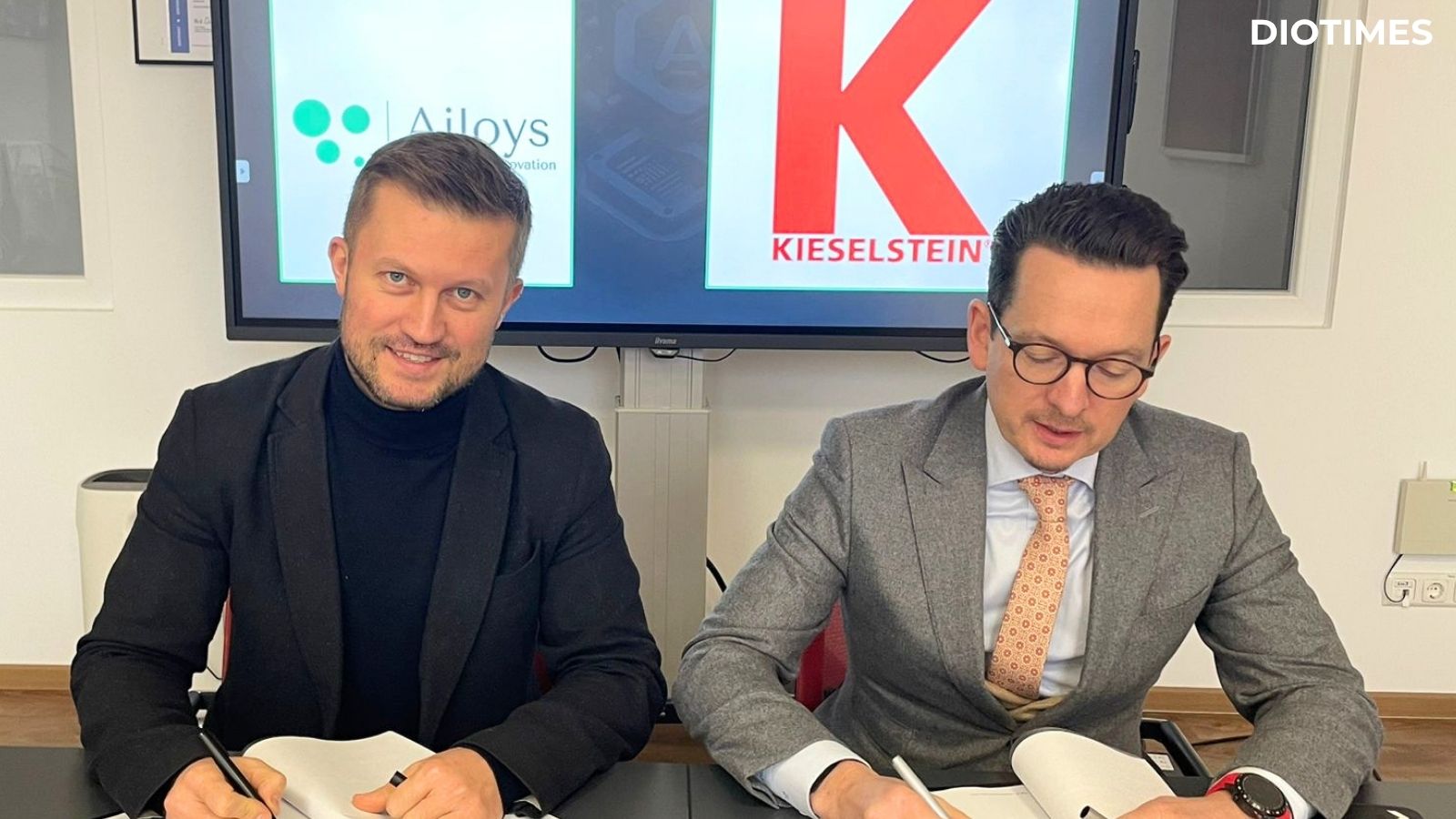
You have both a deep technical background and an Executive MBA from IESE Business School. What do you think is more important for running a startup: technical expertise or business education?
For a deep-tech startup, technical expertise comes first. If you cannot evaluate whether your product actually works or whether your team is on the right track, no amount of business strategy will save you. I have seen companies where management could not tell the difference between a real technical milestone and a demo that looks impressive but falls apart in the field. That is a dangerous situation.
That said, the MBA gave me something I was missing. I learned how to speak to investors in their language, how to think about go-to-market strategy, and how to build financial models that reflect what hardware-software deployment actually costs in industrial settings. These are practical skills, not theoretical ones.
But honestly, the most important thing I gained from business education was perspective. When your hardware engineer says a sensor mounting approach will not work in a specific factory environment, or your ML engineer says the model needs more data from a particular process, you need to evaluate that. Not just trust it blindly, and not dismiss it because it is inconvenient for the timeline. You need to ask the right questions and then make decisions grounded in reality.
To me, that is what leadership looks like in deep tech: the ability to listen carefully and act with informed judgment.
Your participation in the “Doing Business in Africa” program signals an interest in emerging markets. How do you see Industrial AI evolving in developing or energy-constrained economies?
This is where Industrial AI can have its most meaningful impact.
Developing economies often operate in brownfield environments with machines that are 20, 30, sometimes 40 years old. These machines still work, and replacing them requires capital that is simply not available. The standard Silicon Valley answer of replacing everything with the latest smart factory equipment does not apply.
Our approach is fundamentally different. Ailoys mounts sensors on existing machines, requires no controller modifications, no MES integration, and no cloud dependency. The edge computing architecture means it works in environments with unreliable connectivity. The entire system is designed to make brownfield installations smarter, not replace them.
Our customers do not need to invest upfront in expensive infrastructure. They pay for the output and results we deliver, not for hardware sitting on the shelf.
For energy-constrained economies, there is a direct benefit: when you detect tool wear before it causes defective output, you eliminate waste. When you optimize process parameters in real time, you reduce energy consumption per unit produced. These are not marginal improvements. In wire drawing and tube production, we are talking about double-digit reductions in scrap rates and meaningful energy savings.
Industrial AI should not be a technology that only wealthy economies can afford. If it is designed correctly—low infrastructure requirements, low deployment costs, and results-based pricing—it becomes a tool for industrial development, not just industrial optimization.
Technology & Industry Vision
How do you define leadership in a deep-tech company operating at the intersection of AI, manufacturing, and energy?
Leadership in deep tech is about managing uncertainty at multiple levels simultaneously. There is technical risk: will the physics work at scale? There is commercial risk: will traditional manufacturers adopt AI-driven tools? And there is organizational risk: can you attract and retain talent that is rare in the market?
The temptation is to overpromise. Industrial AI is full of impressive demos that collapse on a real factory floor. Our approach is different: we deploy at our own cost on real production lines and let the data speak. We do not sell a vision; we prove a result. Then we charge for the value we deliver. That changes the conversation with customers entirely. We are not asking them to bet on us; we are asking them to measure us.
There is another dimension that matters in hardware-intensive deep tech. You cannot iterate as quickly as a pure software company. A sensor design decision made today will be in the field for years. That forces a discipline different from the typical startup mentality. You must be both ambitious and careful. You must know when to move fast and when to slow down and get the engineering right.
For me, leadership means holding those instincts in balance and communicating honestly with investors, customers, and the team about where we are and where we are going.
You often describe Industrial AI as infrastructure rather than automation. What fundamentally distinguishes these two paradigms?
Automation replaces a human action with a machine action. It is rule-based, process-specific, and designed to optimize a known sequence. It works well when conditions are predictable and stable.
Infrastructure is fundamentally different. When we say Ailoys is industrial AI infrastructure, we mean it literally.
Think of it as building a nervous system for manufacturing. Our sensors are the nerve endings that feel what is happening at every critical point in the process. The edge devices are the spine, collecting and processing signals locally in real time. The AI layer is the brain, interpreting signals, learning patterns, and guiding decisions.
By building this nervous system, we are laying the foundation for what we believe is the real goal: a manufacturing operating system. Not an app built in ten minutes of coding. A true operational system that runs production, adapts to changing conditions, and improves over time. That cannot exist without the sensing infrastructure beneath it.
The practical difference for a manufacturer is significant. An automation solution typically requires deep integration with a specific machine controller. It is expensive to deploy, hard to scale, and becomes obsolete when the machine is upgraded.
Our approach is the opposite: mount the sensors, connect them to the edge device, and within days the system begins learning the process. No controller modifications. No factory downtime for installation.
This distinction matters for digital strategy as well. Automation is a cost center: one solution per one problem. Infrastructure is a capability that compounds. Every additional deployment adds to the data foundation, improves the AI models, and creates more value across the entire operation.
That compounding effect is what makes the nervous system analogy so appropriate. The more nodes you connect, the smarter the entire system becomes.
In energy-intensive industries such as metallurgy and battery manufacturing, what measurable impact can digital twins and data-driven operations realistically deliver?
We are careful to distinguish between marketing claims and validated results.
In our wire drawing deployments, we have measured scrap rate reductions of up to 30% through early tool wear detection. In tube production for medical devices, real-time monitoring of forming forces and vibration patterns identified wall thickness deviations that were previously detected only through destructive testing at the end of a shift.
In metal additive manufacturing for aerospace, our system assesses both macrostructure and microstructure in real time, giving the machine continuous feedback on the structural integrity of what it is producing. The machine effectively understands the structure it is building, layer by layer.
The scale of the problem is substantial. According to a Siemens study, the world’s 500 largest companies lose approximately $1.4 trillion annually to unplanned downtime—equivalent to 11% of their total revenues. Deloitte projects 2.1 million unfilled manufacturing jobs by 2030 as experienced operators retire. Over 70% of manufacturing equipment in North America is more than 20 years old, with no native digital connectivity.
These figures represent real production lines running without the intelligence they need, staffed by fewer and fewer people who know how to keep them operating efficiently.
The digital twin concept is powerful but often oversold. A useful digital twin is not a 3D visualization of a factory. It is a physics-informed AI model that represents the stable operating envelope of a specific process and flags deviations in real time.
That is what we build: practical, process-specific models that operators can act on immediately.
The energy impact follows directly. When you reduce scrap, you eliminate the energy consumed to produce defective output. When you optimize process parameters, you reduce energy consumed per acceptable unit. In energy-intensive industries like metallurgy, these improvements translate directly into lower costs and a reduced carbon footprint.
Customers pay for outcomes, not for the technology itself. If we do not deliver measurable improvements, we have not earned anything.
Many manufacturers operate in brownfield environments with established equipment. How can AI and IIoT extend the operational life of existing industrial assets without requiring major capital replacement?
This principle is central to Ailoys’ design philosophy. Most manufacturers cannot—and should not—replace their existing equipment. A wire drawing machine from the 1990s or a tube welding line from the early 2000s can still produce high-quality output. The problem is not the machine itself. The problem is that the machine has no way to communicate what is happening inside the process.
Our solution is to give these machines a voice.
We mount acoustic emission sensors and vibration sensors on the machine housing and connect them to an edge computing device. Within a short deployment period, the AI learns the normal operating signature of that specific machine. From that point forward, it detects anomalies, predicts maintenance needs, and provides operators with actionable guidance.
This is especially important given the aging workforce challenge. When an experienced operator retires, decades of accumulated process knowledge leave with them. The new operator cannot replicate 20 or 30 years of intuition overnight.
Ailoys captures that knowledge digitally. The system learns what “normal” looks like for each machine and flags deviations the way an experienced operator would—except it does so 24 hours a day, without fatigue, across every machine simultaneously.
The key technical decisions that enable this approach are non-invasive sensor mounting requiring no mechanical modification, edge processing requiring no cloud connectivity, and an AI architecture that adapts to each machine individually.
As a result, a manufacturer can invest a fraction of the cost of a new machine while gaining capabilities that even new machines often do not offer. We are upgrading the intelligence of the production line without physically altering it.
Global Perspective & Strategy
From your experience working across Europe and Asia, what structural differences do you observe in how these regions approach industrial digitalization and energy efficiency?
Europe benefits from strong regulatory frameworks that push manufacturers toward efficiency and sustainability, but adoption of new technology can be cautious. Decision-making in traditional European manufacturing organizations often requires multiple levels of approval and extended validation cycles. The advantage is that once a European manufacturer commits, implementation is thorough and relationships tend to be long-term.
Asia, particularly countries such as South Korea and Japan, exhibits a different dynamic. There is a strong cultural alignment between manufacturing excellence and technology adoption. The philosophy of continuous improvement creates natural receptivity to tools that provide real-time process intelligence.
Asian manufacturers are often faster to pilot new technologies and more willing to invest in process-level data collection. That speed matters. In our experience, factories that move quickly to adopt sensing and AI are the ones that see results quickly, creating a virtuous cycle.
The most interesting convergence lies in a shared challenge: the aging industrial workforce.
This is not a distant forecast—it is happening now. In Europe, experienced operators are retiring faster than they can be replaced. In Asia, the same demographic shift is underway even as production complexity increases.
A generation of operators who could diagnose machine issues by listening to subtle sounds or feeling vibration patterns—knowledge that was rarely documented—is leaving the factory floor.
This is precisely where AI-driven process intelligence shifts from competitive advantage to operational necessity. Knowledge that once existed only in individual experience must now be captured, formalized, and embedded into intelligent systems.
As energy transition reshapes global industrial economics, how should manufacturing leaders rethink operational strategy and competitiveness?
The energy transition is not merely about switching power sources. It is about fundamentally rethinking how much energy goes into every unit of output.
Manufacturing leaders who focus only on renewable energy procurement while ignoring operational efficiency will find themselves at a disadvantage.
The most impactful lever is reducing waste within the process itself. Every defective part, unnecessary machine cycle, and unplanned stoppage represents energy consumed without productive output.
AI-driven process monitoring addresses this directly, and the return on investment is measurable from day one. Scrap that did not occur, energy that was not wasted, downtime that was avoided—these are quantifiable metrics.
There is also a competitiveness dimension. Customers in automotive, aerospace, and energy sectors increasingly demand traceability and sustainability data across supply chains.
Manufacturers able to demonstrate, with data, optimized processes and minimized waste gain a commercial advantage. Those who cannot risk losing contracts.
Digitalization and sustainability should not be treated as separate initiatives. They are fundamentally the same initiative. The data infrastructure used to optimize quality and efficiency also generates the sustainability metrics required by regulators and customers.
Build it once, and it serves both purposes.
I also strongly believe in creating internal innovation spaces within corporations—environments where unconventional ideas have an opportunity to prove themselves. The most valuable innovations often originate from within business units, from individuals closest to daily operational challenges.
Set clear KPIs, create open innovation frameworks, and allow experimentation. The results can be transformative.
What is Ailoys’ long-term strategic ambition, and looking ten years ahead, what kind of industrial system do you hope your work will help build?
Our ambition is to build the foundation of the dark factory—but from the bottom up.
Industrial conglomerates often approach this vision through billion-dollar greenfield installations and multi-year system overhauls. We take a different path: one device, one machine at a time, on equipment that already exists.
We see four layers in this journey.
First, sense: the device listens to the process, detects defects, and alerts the operator. This is already operational across our customer installations.
Second, decide: AI agents make real-time process decisions autonomously—triggering corrective actions, ejecting defective parts, signaling tool changes, or slowing the process before failure occurs. We are currently piloting this capability.
Third, orchestrate: multiple Ailoys devices on the same production line communicate with each other. An upstream defect is detected, and the downstream machine automatically adjusts its parameters. The production line self-optimizes as a coordinated system.
Fourth, the dark factory: full closed-loop production. Machines self-tune, self-correct, and self-maintain. Raw material enters; finished product exits. Lights off.
Many industrial automation companies describe similar visions. The difference is that we make it accessible to the vast majority of factories that will never rebuild from scratch.
Each device we deploy delivers immediate, quantifiable value today—reduced scrap, energy savings, fewer unplanned stoppages, and preservation of institutional knowledge—while contributing to a larger, evolving system over time.
Ten years from now, I hope we look back at the way factories operated in 2026 and find it difficult to believe that critical processes ran without real-time process intelligence.
The technology exists today. Our responsibility is to make it accessible, affordable, and universal.